Looking for a way to use those Thanksgiving leftovers without actually eating them? Smear them on yourself! Apparently, there are scientific reasons why leftovers like pumpkin pie, cranberry sauce, and mashed potatoes may be better on your body than in. Here's a challenge: can you pick them all out?
http://improbable.com/2010/11/27/smear-thanksgiving-leftover-food-on-your-body/?utm_source=feedburner&utm_medium=feed&utm_campaign=Feed:+ImprobableResearch+(Improbable+Research) Which leads to http://www.aolnews.com/weird-news/article/pumpkin-pie-facial-use-thanksgiving-leftovers-for-skin-care/19729777
Showing posts with label Medical. Show all posts
Showing posts with label Medical. Show all posts
Saturday, November 27, 2010


Wednesday, June 9, 2010
Got Science?
I know this is a little off topic, but I was just thinking about the possibility of civilizations before us and aliens. I know it's improbable for intelligent life to develop before us, but if it did happen, would there even be evidence? Take for instance, our society. We use all sorts of materials that last a loonnngg time, so people can dig up artifacts from, say, the Native Americans of long ago. However, everything that we've done is incredibly small compared to the Earth's history- we've only been around for, say, a million or so years while the Earth's been around for about 4.6 billion years (and correct me if I'm wrong). Also, even though the stuff we make may last a long time, I don't think that 500 million years from now, it would still be here. Even glass, which lasts a long time, will only last one million years: compare that to the dinosaurs of 200 million years ago. So if there was, say, really smart dinosaurs, would there be any evidence to prove it? Especially if those really smart dinosaurs were smart enough to dispose of their waste properly.
The answer to the question this week: quite simply, we can't tickle ourselves because it isn't a surprise. Our brain can anticipate our own movements (what a shocker), so when we tickle ourselves, we don't get that panicky feeling that causes the being-tickled reaction. After all, it's only yourself, so your brain doesn't raise a fuss.
Now, one last announcement: there MAY be a special luncheon or lab for the TOP TEN answerer's of the question box. Things considered: how many times you answered and the quality of your answers. When the final details of the special luncheon or lab are determined, then the list of winners will be compiled and posted on the blog- so keep on answering!
awesome_spectacular's comments: Great job this week- we got a lot of answers. The quality of the answers is way improving! About Pippin's comments on the aliens and stuff (way off topic!), I think that you're right about the glass lasting only about probably a million years. Not all resources last forever because some resources are renewal and others are non renewal (hint! hint! S.S.!) I feel that even the renewable stuff we make may last a really really long time, but I don't really think it could last forever. I guess I got off topic too! Anyway, you guys are doing a awesome job, so just keep answering!
The answer to the question this week: quite simply, we can't tickle ourselves because it isn't a surprise. Our brain can anticipate our own movements (what a shocker), so when we tickle ourselves, we don't get that panicky feeling that causes the being-tickled reaction. After all, it's only yourself, so your brain doesn't raise a fuss.
Now, one last announcement: there MAY be a special luncheon or lab for the TOP TEN answerer's of the question box. Things considered: how many times you answered and the quality of your answers. When the final details of the special luncheon or lab are determined, then the list of winners will be compiled and posted on the blog- so keep on answering!
awesome_spectacular's comments: Great job this week- we got a lot of answers. The quality of the answers is way improving! About Pippin's comments on the aliens and stuff (way off topic!), I think that you're right about the glass lasting only about probably a million years. Not all resources last forever because some resources are renewal and others are non renewal (hint! hint! S.S.!) I feel that even the renewable stuff we make may last a really really long time, but I don't really think it could last forever. I guess I got off topic too! Anyway, you guys are doing a awesome job, so just keep answering!
Wednesday, June 2, 2010
Got Science?
I was just watching Bill Nye on the news, talking about the Gulf oil spill, and he started talking about how we need more of America's youth to go into concrete science, rather than economics or banking or whatnot. And so, I decided that now is a good time to truly discuss what the question box is about, as its purpose, I feel, is beginning to drown amongst the goodie bags, extra credit, and other frilly stuff.
The Question Box wasn't meant as a way for me to get rid of all of my Halloween candy, even if that's what it seems. Nor was it meant as a quick and easy way to boost your grades. It isn't even about the ultra-cool bulletin board that is now wallpapered in pictures and articles. It's about getting you interested in science, and hopefully swaying some of you to pursue science careers in the future. Science isn't boring, even if you fall asleep in science class. It's the field of curiosity, where you think of questions- and try to answer them. It's the field of creation, where our techno-people think of neat gadgets like the iPhone for the rest of us to enjoy. It's the field of solutions, where our greatest minds try to solve the problems of today, like BP's oil spill. I'm not saying that you have to become a scientist or engineer, but that it's not as boring as you think. In fact, here's how E. Robert Schulman put the purpose of science in his comical How to Write a Scientific Paper:
That's also why you should do your science homework. :)
Tired out, are you? I'll keep the answer to this week's question brief, because I need to do my homework and I'm sure you do too. We need to sit upright on roller coasters because of G-forces. If we don't, all these G-forces won't be distributed evenly and parts of us would feel heavier than others. I'll come back to this topic later (hopefully) because I need to do more reading. Here are some links about roller coasters:http://www.rollercoasterking.com/thrill-experience/http://www.themeparkinsider.com/safety/http://fun.familyeducation.com/summer/safety/35168.htmlhttp://cec.chebucto.org/Co-Phys.html And thanks to njguy for the neat video. I don't think I'll ever go on Kingda Ka- way too scary for me.
By the way, if you'd like to comment on anything, feel free to do so.
The Question Box wasn't meant as a way for me to get rid of all of my Halloween candy, even if that's what it seems. Nor was it meant as a quick and easy way to boost your grades. It isn't even about the ultra-cool bulletin board that is now wallpapered in pictures and articles. It's about getting you interested in science, and hopefully swaying some of you to pursue science careers in the future. Science isn't boring, even if you fall asleep in science class. It's the field of curiosity, where you think of questions- and try to answer them. It's the field of creation, where our techno-people think of neat gadgets like the iPhone for the rest of us to enjoy. It's the field of solutions, where our greatest minds try to solve the problems of today, like BP's oil spill. I'm not saying that you have to become a scientist or engineer, but that it's not as boring as you think. In fact, here's how E. Robert Schulman put the purpose of science in his comical How to Write a Scientific Paper:
The purpose of science is to get paid for doing fun stuff if you're not a good enough programmer to write computer games for a living (Schulman et al. 1991).While it's meant to be a joke, that's what scientists do: they research "stuff" that they want to find out, and they get paid for doing it. Just watch the Discovery Channel. Those people are getting paid for living an adventure! No one is more fun, or funny than the Myth Busters and all they do all day is experiment. Having someone pay you to sit around and ask questions is a wonderful career. Want to know why clouds break up? Or why people have a tendency to eat the ears off of marshmallow peeps first? Scientists are the ones who get paid to find the answer: they research the topic, come up with a guess to the answer, and try out their guess in a made up scenario, an experiment. Then, they try to figure out what just happened and whether or not they were right. But you don't need me to tell you this, this is what every science teacher is telling you! Hypothesis: I think people like to eat the ears of marshmallow peeps. Observation: watching people vote on my marshmallow peep poll. Data: The results of my poll (scroll down to see). Conclusion: it's either always or never, but rarely in between. This is what science teachers are constantly telling you, but it's simpler than they make it seem (sorry Sunnyd). This big vocabulary, observation, analysis, etc. is scaring people away from science, if you ask me. And that's what the question box is about: going back to the root of science so that we don't forget the essence of it. It's here to remind you that science is an explanation for simple things in life, facts about our world. And when we put facts together, we come up with all sorts of interesting stuff: the same concept of "convection" that makes the Earth's surface move makes our jello turn solid and makes heating up a house with an oven highly ineffective (Trust me, don't try it. It could cause your oven to break, like ours did). The same concept of gravity that makes the moon go 'round our heads makes apples fall to the ground. And when we try to use these concepts for ourselves, we make life easier: a fan helps cool your jello dessert in time for dinner, a fireplace heats up your house quickly and effectively (relatively speaking), gravity makes bungee jumping all the more thrilling... This is what science is about. And it is ultra-important to your life, my life, and the development of mankind.
That's also why you should do your science homework. :)
Tired out, are you? I'll keep the answer to this week's question brief, because I need to do my homework and I'm sure you do too. We need to sit upright on roller coasters because of G-forces. If we don't, all these G-forces won't be distributed evenly and parts of us would feel heavier than others. I'll come back to this topic later (hopefully) because I need to do more reading. Here are some links about roller coasters:http://www.rollercoasterking.com/thrill-experience/http://www.themeparkinsider.com/safety/http://fun.familyeducation.com/summer/safety/35168.htmlhttp://cec.chebucto.org/Co-Phys.html And thanks to njguy for the neat video. I don't think I'll ever go on Kingda Ka- way too scary for me.
By the way, if you'd like to comment on anything, feel free to do so.
Wednesday, May 26, 2010
Pippin's Question Box
Why are we told to sit upright on roller coasters? (and what happens if we don't?) Best
Wednesday, May 12, 2010
Got Science
I must say, this was a pretty difficult question to answer! For all those Question Box Answerer's this week, great links!
From what I researched, it pretty much depends on, basically, your body and how tolerant you are. It depends on how many fumes there are, and how much you inhale. If you inhale enough of it, you could possibly get drunk, although you would feel a little dizzy first. This is because the main chemical in alcohol is ethanol. Ethanol is also known as grain alcohol, pure alcohol, or drinking alcohol, along with many other names. Ethanol is one of the oldest recreational drugs. As iluvmusic said, alcohol is not an inhalant, it is still really harmful to your body. If you inhale enough to get you drunk, it will enter your bloodstream, which can be highly harmful to your body.
~Awesome_Spectacular1009
Pippin's comments: I have to wonder though: if you can get drunk on ethanol, couldn't that be a major problem in considering bio fuels? After all, when we go to fill up our tank on gasoline, we smell gasoline fumes. Therefore, if drivers fill up their tank and catch a whiff or two of alcohol, then that will be almost the equivalent of putting (slightly) drunk drivers on the road- and that could be rather hazardous. Wouldn't that mean, then, engineers would have to design a completely leak-proof ethanol dispensing system so as to avoid doing that to drivers? Plus, even our gasoline systems are (clearly) not leak proof, so I highly doubt we'd been able to create an entirely leak-proof ethanol system that every fuel station would embrace and maintain properly. Hmmm... well, just something to think about!
Links: http://en.wikipedia.org/wiki/Alcohol
http://www.independent.co.uk/life-style/health-and-families/health-news/health-drunk-but-not-a-drop-passed-my-lips-did-you-know-that-you-can-get-tipsy-simply-by-breathing-in-the-fumes-from-other-peoples-booze-rob-stepney-looks-at-the-risks-and-possibilities-of-passive-drinking-1469632.html
From what I researched, it pretty much depends on, basically, your body and how tolerant you are. It depends on how many fumes there are, and how much you inhale. If you inhale enough of it, you could possibly get drunk, although you would feel a little dizzy first. This is because the main chemical in alcohol is ethanol. Ethanol is also known as grain alcohol, pure alcohol, or drinking alcohol, along with many other names. Ethanol is one of the oldest recreational drugs. As iluvmusic said, alcohol is not an inhalant, it is still really harmful to your body. If you inhale enough to get you drunk, it will enter your bloodstream, which can be highly harmful to your body.
~Awesome_Spectacular1009
Pippin's comments: I have to wonder though: if you can get drunk on ethanol, couldn't that be a major problem in considering bio fuels? After all, when we go to fill up our tank on gasoline, we smell gasoline fumes. Therefore, if drivers fill up their tank and catch a whiff or two of alcohol, then that will be almost the equivalent of putting (slightly) drunk drivers on the road- and that could be rather hazardous. Wouldn't that mean, then, engineers would have to design a completely leak-proof ethanol dispensing system so as to avoid doing that to drivers? Plus, even our gasoline systems are (clearly) not leak proof, so I highly doubt we'd been able to create an entirely leak-proof ethanol system that every fuel station would embrace and maintain properly. Hmmm... well, just something to think about!
Links: http://en.wikipedia.org/wiki/Alcohol
http://www.independent.co.uk/life-style/health-and-families/health-news/health-drunk-but-not-a-drop-passed-my-lips-did-you-know-that-you-can-get-tipsy-simply-by-breathing-in-the-fumes-from-other-peoples-booze-rob-stepney-looks-at-the-risks-and-possibilities-of-passive-drinking-1469632.html
Wednesday, May 5, 2010
Wednesday, April 28, 2010
Got Science?
Apparently, I got the question wrong- it's not really a mosquito whine, but a mosquito ringtone. Hmm, close enough.
This is a relatively simple question to answer, so I'll keep it brief. Basically, adults can't hear the mosquito ringtone (which is actually simply a really high pitched sound) because their ears are getting old, a condition known as presbyacusis. And I'll stop there before I start giving out rather unfavorable ideas.
This is a relatively simple question to answer, so I'll keep it brief. Basically, adults can't hear the mosquito ringtone (which is actually simply a really high pitched sound) because their ears are getting old, a condition known as presbyacusis. And I'll stop there before I start giving out rather unfavorable ideas.
Can you hear the tones? Check out this link:
Also, here are the winners for this week's question box:
cookiesncream
soccer_bug0912
Toad Rockz
Congratulations!!
Wednesday, March 17, 2010
Pippin's Question Box
In honor of Brain Awareness Week, we're taking a break from physics:
Choose an article from Neuroscience for Kids and summarize what you learned. If you don't know what to choose and want to do ol' Pippin a favor, explain action potential. I don't quite get it!
Choose an article from Neuroscience for Kids and summarize what you learned. If you don't know what to choose and want to do ol' Pippin a favor, explain action potential. I don't quite get it!
Tuesday, March 16, 2010
The Brain, Part Two
Happy Brain Awareness Week, everyone! No joke, March 15th- 21th is really, truly brain awareness week- and I didn't make this up.
I have just discovered that there is a book from the Society for Neuroscience that you can read online! It is called Brain Facts and is supposed to be a (74 page long) introduction to neuroscience. Pretty amazing, isn't it?
Oh, my brain hurts- figuratively. The lesson for part two shall be neurons. Neurons are the cells that make up your brain- cells, if you recall, are not just stuff, but the basic units of life. Before you jump on me with a dozen "neurons aren't the only stuff in your brain," though, note that, yes, neurons aren't the only stuff in your brain. However, they are the most well known and are the basic working cell in your brain. There are three main parts: the cell body, or soma, the axon, and dendrite. The cell body is something we should be familiar with, since we covered cells in genetics: it contains the nucleus and the organelles. Dendrites and axons are specialized extensions (like an arm and a leg, but neurons don't walk) of the neuron. Wait, a picture would help, wouldn't it? Here we go:
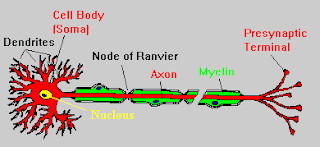
Dendrites, those little things that branch out from the cell body, receive signals from other cells. The axon sends signals out. Think of it this way: dendrites in, axons out. Simple enough, right? Take a breather to put that in your head. Ready? The points at which two cells contact each other is called a synapse. I say contact because they don't actually touch. Now, this vocabulary is nice and all, but how do the cells work, you ask? Good question- I don't really know. The gist of what I do know, however, is that the nerve cell, when at rest, has a natural (I believe negative, though I'm not so sure) charge. However, when a cell sends a signal to the neuron, it generates an electric charge that goes to end of the axon, what the diagram depicts as the presynaptic terminal, which then releases neurotransmitters (chemicals) to the next neuron, which generates an electric charge, etc. If you want something more detailed, check out this website about the action potential, which explains how electrical pulses move along a neuron. In fact, if someone can explain how action potential works to me, I'd be delighted! In order to help the electric charge move along, the axon is covered in a sheath of mylelin. As the neurotransmitters (remember, chemicals) are released at the presynaptic terminal in little packets called quanta, it travels across a little gap called the synaptic cleft and binds to receptors on the next cell, which may cause that cell to fire an electric charge as well. Now, I don't know about you, but it's going to take a little while for that to soak in my brain. Look for more information in Part Three of The Brain!
Disclaimer: Seeing as I'm a student, this information may be invalid or not quite true- I'm still trying to figure it out and organize my thoughts in these posts!
Sources: http://www.sfn.org/skins/main/pdf/brainfacts/2008/brain_facts.pdf
http://nobelprize.org/educational_games/medicine/nerve_signaling/
http://faculty.washington.edu/chudler/cells.html
Saturday, March 6, 2010
Science Buzz: The Brain, Part One
I've been checking out a website from a club about the brain and discovered that it was The website for neurology- a treasure trove of information! So I've decided to start to post things that I learn in hopes that I'll remember it past today. (Look at Neuroscience for Kids on my Cool Links! gadget)
What is the most important three pounds of stuff in your life? If you said your laptop, your cell phone, and your ipod, you're wrong (or at least, you should be). It's your BRAIN! Yes, this mass of tissue and neurons and chemicals and electrical energy dominates everything about you. Without it, you'd be food for the buzzards. And so, let us begin the journey into the most important thing in our life: our brain.
Parietal Lobe: Your touch center
Occipitual Lobe: Your sight center
Temporal Lobe: Your memory and hearing
Information from: http://faculty.washington.edu/chudler/lobe.html
What is the most important three pounds of stuff in your life? If you said your laptop, your cell phone, and your ipod, you're wrong (or at least, you should be). It's your BRAIN! Yes, this mass of tissue and neurons and chemicals and electrical energy dominates everything about you. Without it, you'd be food for the buzzards. And so, let us begin the journey into the most important thing in our life: our brain.
To start off, let's look at a picture of a brain (from the website):
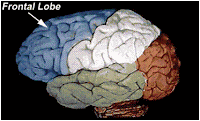
Obviously, your brain isn't this colorful normally. But since we're going to dicuss the lobes of the brain, the colors will come in handy.
Let's start off with the frontal lobe. This lobe is associated with "intellectual" stuff, like reasoning, emotions, problem-solving, parts of speech, and movement. Found it! Here's an article talking about how we teens act the way we do- it's because our frontal lobes aren't fully connected with the rest of our brain. Doesn't that explain a lot? The next lobe, the white one, is the parietal lobe. This is where we process touch related things, such as pressure and pain. The next lobe is the occipitual lobe, where we process information related to vision. Finally, the green lobe is the temporal lobe, associated with memory and hearing. Of course, your brain is probably snoozing at this point (and I want to get started on my Physics title page) so I'll put more information in The Brain, Part Two. Just keep in mind, though, that the brain is a complicated organ and that these are simply lobes in the brain.
To sum up:
Frontal Lobe: Your reasoningParietal Lobe: Your touch center
Occipitual Lobe: Your sight center
Temporal Lobe: Your memory and hearing
Information from: http://faculty.washington.edu/chudler/lobe.html
Wednesday, October 21, 2009
Science Book, Take a Look: Going Nuts?
This book is not about psychology, but its somewhat more scientific counterpart: Neurology, or the science of the brain. There are many, many strange tales of patients with diseases of the brain...
Newton's Madness: Further Tales of Clinical Neurology
by Harold L. Klawans, M.D.
I found this a really engaging read. They're basically the stories of patients (well, most) that the author encountered as a neurologist who works in a hospital and diagnoses people. Some of the diseases many people know about, like a stroke, while others aren't so common. He explains how he does things pretty clearly (hey, this isn't for doctors but everyday folk like you and me) although all the chemicals like dopamine and serotonin and other big fancy medical terms (with the exception of morbidly obese, which I think most people know) can make your head spin if you try to keep track of them all (which I didn't). My favorite chapter in the book was chapter 18, "The Girl with the Dancing Eyes," which was simply hilarious- or at least the first half was. I won't tell anything about this chapter except this tidbit: bouncing guinea pigs. An example of the type of diseases, or rather, problems with the brain (by far not the most exotic, though) that the author discusses was a stroke, in the first chapter. While a stroke is pretty basic knowledge, the stroke that the author has to diagnose belongs to none other but one of his mother's very close friends- "Aunt Betty." In this case, the stroke patient was taken to the hospital, but the patient had no idea what was wrong! Aunt Betty had lost all control and feeling in her left arm or hand- in fact, when the author held it up for her to see, she thought it was the neurologist's hand, not her own. The author later goes on to explain this more thoroughly.
Here are some tips if you do read this book:First, read all the quotes that the chapter starts out with. You probably should for all books, but these are really interesting (same goes for the Michio Kaku books, he has some awesome quotes in there).
Second, read all the author's notes at the end of the chapter. There are hidden goodies in there that are definately worth reading, especially in Chapter 18.
Third, and this goes for most of the books I would put up, this is not a quick read. It is a book written for adults, and while it's not super long, it definately needs you to take your time and read it. If you need a book for Lit, don't read this just for the 10 points- or rather, read a fantasy book for the 10 points and read this for the sake of reading (which you should be doing in the first place).
Fourth, I have a question that I would be very grateful if someone could answer: this book has an entire chapter devoted to Sherlock Holmes, his possible drug addiction, and how he probably visited Dr. Sigmund Freud during the three years that he "disappeared." So, considering that Sigmund Freud existed and real people don't really get visits from fictional characters all that often, was Sherlock Holmes real? Kokopelli1015 said that Sherlock Holmes didn't, but that makes everything make less sense. Not that I don't believe Kokopelli1015, but if you happen to read the book or just know about Sherlock Holmes, feel free to share your opinion on this topic (or anything in the book).
Sunday, October 18, 2009
Science Flash: Flies with Fake Flashbacks?
I remember discussing with a friend of mine how weird it would be if we could manipulate our own dreams not so long ago. Of course, manipulating dreams implies that we could manipulate other things in our heads as well- not quite a good thing in the wrong hands, but a cool concept. Now, it seems as though scientists are starting to get there.
In the article, they also discuss an interesting point that I find is worthwhile to contemplate: intelligence from something, well, non-intelligent: "the physical interactions between cells and molecules." What they mean is that all of our "intelligence" can be reduced to what happens between our neurons- the capability to create memories, have thoughts, and carry out other advanced functions. So, in a sense, I can type this article because of the reactions and interactions between the neurons in my brain. I think it's kind of like how the computer can do all of the things it does from 1's and 0's, or how we can form so many words from the letters of the alphabet- creating complex things from simple materials. Still, my question is: if we messed with those "physical interactions," would that mean we are messing with our brains?
The article also discusses another point in the last paragraph that has to do with my question: the fly of a brain can probably tell us a lot about how more complicated brains like ours work. As we look more into how brains work, in simple and complex organisms, will there come a time when we can manipulate our own brains? When we can choose what we dream at night, or "delete" memories, or even mess with ourselves so much that we become completely different? While such precise control as choosing our dreams is probably far in the future (hopefully), we are already messing with our minds- and fixing them as well, in some cases. Take drugs, for instance. When people smoke, the nicotine can go to our brain and coat our neurons in an unhealthy layer of the stuff- slowing down our thoughts and messing with our brains, in way. Conversely, when our brain lacks certain chemicals, we can now "fix" ourselves, at least for a while, by supplying that chemical. For instance, people with Parkinson's disease, a disease that slowly destroys neurons in the brain (in a book I read, one patient described it as being a lizard that is cold and frozen, and needs the sun to warm it up to move) making movement more and more difficult. One of the reasons for this is the lack of dopamine, a chemical produced in the brain that isn't being produced as readily in people in Parkinson's disease. Neurologists can prescribe such patients with L-Dopa, which will turn into dopamine when it gets into the brain, fixing it for a while. Of course, as the disease progresses, the L-Dopa will help less and less, until they eventually succumb to the disease. However, we are still fiddling with our brains in that way.
For now, scientists are only creating false memories in flies, so there's no need to worry about whether our memories are genuine or not- although we create false ones ourselves anyways. (I would launch into a story about an online lecture I heard a bit of while doing research for a memory presentation, but I'm afraid I'll put some unwary person to sleep). While the thought of controlling minds scares me, this discovery still excites me: after all, we are just beginning to tap into the power of our minds. Who knows what people will discover in the field of neurology?
Scientists Give Flies False Memories
This article was about a group of scientists who managed to isolate a couple of neurons (12, to be exact) and manipulate them in a fly so that it would create false memories to avoid a specific odor. If you ask me, this is pretty amazing. Think of it this way: usually, if you watch documentaries or look at brain diagrams, you can see only the sections of the brain that is activated when doing a specific task. These sections contain a lot of neurons that all work together. Think of it this way: the brain of a fly (which I'd guess is really, really small, not to offend the fly) has a few thousand neurons. Humans, who are larger, have a large brain in proportion to our bodies, and have pretty sophisticated brains as well, would have a lot of neurons- just to put things in proportion. Memory, especially, is really complex: whenever we recall a memory, it isn't stored in one part of the brain. Rather, if I were to remember, say, what I ate for breakfast, I would remember the taste, smell, feel, sounds, what it looked like, the words associated with those images and other perceptions, and all these different sections contain many, many neurons that work together to "remember" this event (makes you appreciate your breakfast a lot more, doesn't it?). Now, bearing this in mind, these scientists managed to isolate 12 neurons in the entire brain of the fly (bearing a few thousand neurons) and stimulate these neurons to give the fly an unpleasant memory. Doesn't that just blow you away?
In the article, they also discuss an interesting point that I find is worthwhile to contemplate: intelligence from something, well, non-intelligent: "the physical interactions between cells and molecules." What they mean is that all of our "intelligence" can be reduced to what happens between our neurons- the capability to create memories, have thoughts, and carry out other advanced functions. So, in a sense, I can type this article because of the reactions and interactions between the neurons in my brain. I think it's kind of like how the computer can do all of the things it does from 1's and 0's, or how we can form so many words from the letters of the alphabet- creating complex things from simple materials. Still, my question is: if we messed with those "physical interactions," would that mean we are messing with our brains?
For now, scientists are only creating false memories in flies, so there's no need to worry about whether our memories are genuine or not- although we create false ones ourselves anyways. (I would launch into a story about an online lecture I heard a bit of while doing research for a memory presentation, but I'm afraid I'll put some unwary person to sleep). While the thought of controlling minds scares me, this discovery still excites me: after all, we are just beginning to tap into the power of our minds. Who knows what people will discover in the field of neurology?
Wednesday, October 14, 2009
Science Flash: The Nocebo Effect
I know that everyone's heard of the placebo effect: two groups are given a pill, they are both told that it is the real thing, but one group is actually given a sugar pill. The sugar pill group feels better for some reason, which we call the placebo effect. However, there appears to be a reverse for this: the Nocebo Effect.
The Flip Side of Placebos: The Nocebo Effect
By John Cloud
The placebo effect is when something happens, like taking medicine, and we think that we will get better, and we do, even if the medicine wasn't real. It's like fooling yourself into getting better. In fact, placebo in Latin means, "I shall please," as the article says. However, the opposite of this is the nocebo effect, or "to do harm" in Latin.
The article says that "A nocebo response occurs when the suggestion of a negative effect of an intervention leads to an actual negative outcome." In other words, when someone says something negative, like "That flu shot is going to hurt really badly," then the flu shot will seem to hurt really badly. Also, the negative effects will usually be related to the drug taken, like if the "doctor" says it's likely to cause nausea, then a lot of people will say, "I'm feeling sick." Basically, it's mind over matter in a negative way.
Nobody really knows why the placebo and nocebo effect works. There are probably dozens of theories, but any of them could be right- or wrong. One explanation that the article mentions is that perhaps the worry caused by all the warnings causes the brain to issue certain commands, causing, for instance, pains in the stomach. Another explanation of the (positive) placebo effect is that it evokes certain chemicals, starting the body's own "health-care system," as they say. I think that perhaps the real explanation will be a combination of the two. After all, our thoughts do influence our body. For example, there was a documentary about stress that explained how it can cause numerous health problems. For instance, stomach ulcers were originally thought to be caused by stress. However, they later discovered that it was actually a type of bacteria that caused it, to the great relief of many doctors (an amusing clip goes something like this: "Doc, my stomach really hurts." After diagnosing the patient with stomach ulcers, the doctor, faced with the fact that stress caused them, says, "How's your attitude lately?.... You need to work on your attitude." The patient replies, "I should work on finding a new doctor.") After more research many years later, though, they find that stress causes the body to halt or slow down certain functions, since stress was originally the "flee for your life!" response. One of those functions is repairing the stomach wall (after all, if a lion is after you, you don't really care about your stomach lining at the moment) and chronic stress would, in turn, greatly weaken the stomach wall, causing it to be vulnerable to bacteria and ulcers. So, mind over body really is a genuine thing that we should consider.
Mind over matter is an interesting topic, but what do we do when we don't want our "mind" to rule over our body? The article offers a simple solution: placebo and nocebo is simply a trick of the mind. To outwit it, we must be aware of the effects: in other words, it's "mind over mind."
Subscribe to:
Posts (Atom)